Choosing the wrong feeder type can stall an entire automation line — costing weeks of rework and budget overruns. If you're evaluating part feeding options for the first time, the sheer variety of equipment makes the decision feel overwhelming. Understanding the three types of feeders most commonly used in automated assembly gives you a practical starting point.
The three types of feeders most commonly used in automated part feeding are vibratory bowl feeders, centrifugal feeders, and flexible feeders. Each suits different part geometries, throughput targets, and integration requirements — none is universally superior. The right choice depends on your specific part, cycle rate, and system design.

Below, I'll break down each type by its working principle, ideal use case, and the conditions where it may fail — drawn from real selection discussions and sample tests I've conducted with integrators across Europe.
What is a vibratory bowl feeder?
Vibratory bowl feeders are the oldest and most widely deployed option. But their rigidity becomes a liability when product changeovers are frequent.
A vibratory bowl feeder uses a custom-machined spiral track and mechanical tooling to orient and singulate parts through vibration. It excels at high-speed, single-SKU feeding but requires a new bowl for each part geometry.
When vibratory bowls work well
- High-volume, single-part production — stable cycle rates above 60 ppm for small components
- Parts with consistent geometry — screws, caps, pins
- No frequent changeovers required
When they fail
- Parts are soft, delicate, or scratch-prone — bowl tooling causes cosmetic damage
- Multiple SKUs run on the same line — each variant needs a dedicated bowl (weeks of lead time)
- Part geometry changes even slightly between revisions
What is a centrifugal feeder?
Centrifugal feeders offer higher speeds than bowls for certain parts, but they share the same limitation: dedicated tooling.
A centrifugal feeder uses a spinning disc to accelerate parts outward toward a shaped track that orients them. It achieves very high feed rates for simple, robust components like metal pins or plastic caps.
Ideal conditions
| Factor | Requirement |
|---|---|
| Part weight | Light to medium |
| Geometry | Symmetrical, robust |
| Target speed | >100 ppm possible for suitable parts |
| SKU variety | Low |
Risks
- Fragile or tangled parts jam or break under centrifugal force
- Custom tooling still required per part — not flexible
- Less common in vision-guided robotic cells
What is a flexible feeder?
When part variety is high or vision-guided robotic picking is required, flexible feeders become the practical choice — but they are not suitable for every part or throughput target.
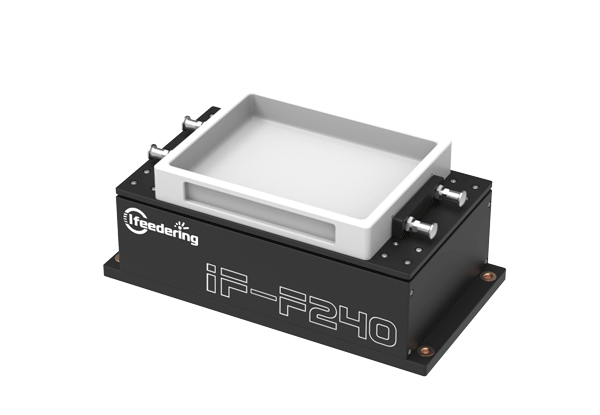
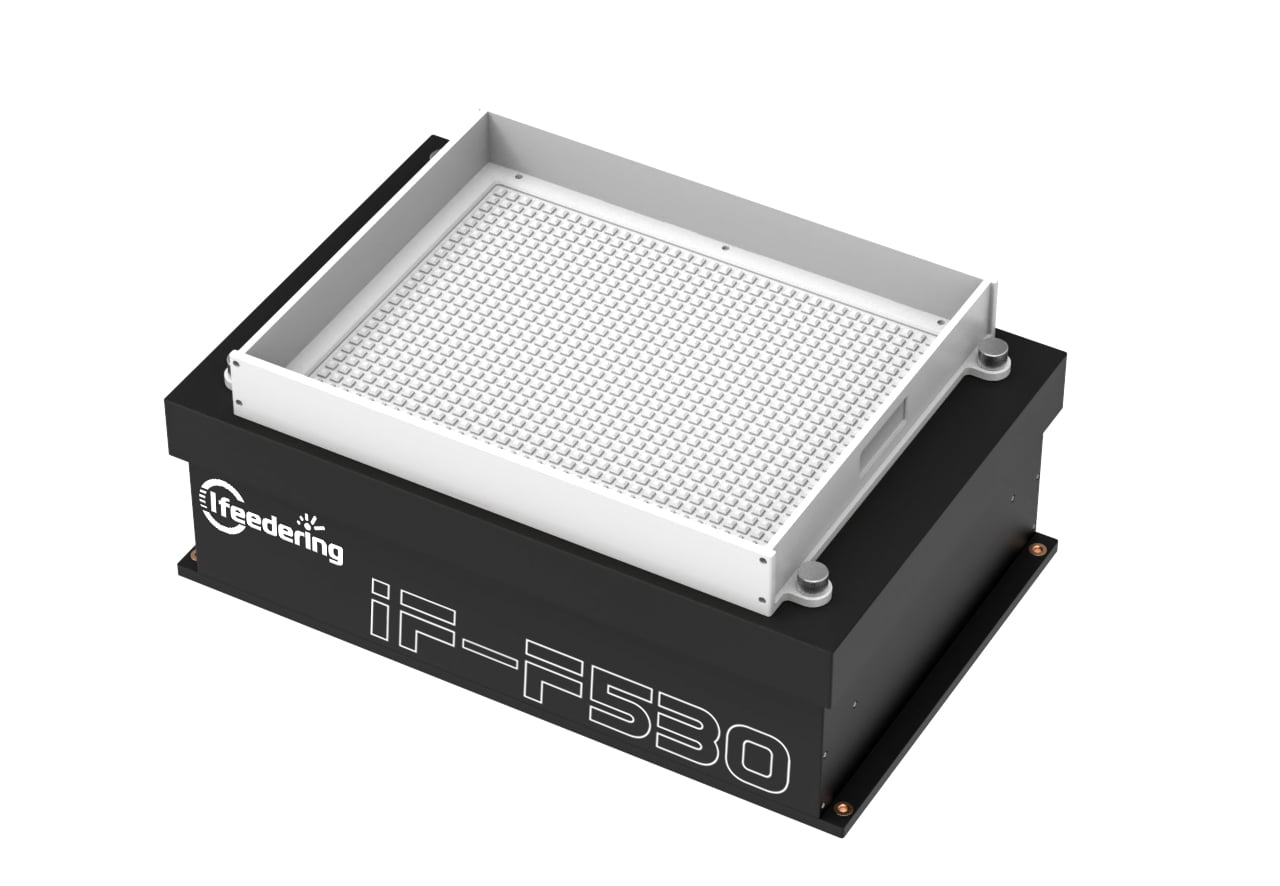
A flexible feeder uses a flat vibrating surface (often backlit) combined with a vision system and robot to identify and pick parts in random orientations. No dedicated tooling is needed; changeover happens through software.
Where flexible feeders excel
- Multi-SKU environments — recipe-based changeover in minutes
- Delicate or cosmetic parts — gentle surface, customizable backlight
- Vision-robot integration — the feeder is designed as part of a complete system
Limitations to evaluate
- Throughput depends heavily on part behavior, vision accuracy, and robot speed — not just the feeder
- Some parts (very sticky, nested, or extremely light) may not separate reliably without extensive testing
- System performance is only proven through sample testing under realistic conditions
I always recommend sending actual parts for a material test before committing. Category-level claims cannot guarantee reliable feeding for your specific component.
Frequently Asked Questions
Which feeder type is fastest?
Speed depends on part geometry and system integration — not feeder type alone. Centrifugal feeders often achieve the highest raw feed rates for simple parts, but real-world throughput requires verifying with your actual material.
Can a flexible feeder replace a vibratory bowl?
In multi-SKU or low-to-medium volume applications, yes. For dedicated high-speed single-part lines, a bowl may still outperform. The decision requires evaluating changeover frequency and part sensitivity.
Do I need a vision system with a flexible feeder?
Yes. Flexible feeders rely on vision-guided robotic picking to identify part position and orientation. The feeder, camera, robot, and gripper form one integrated system.
Conclusion
The three types of feeders — vibratory bowl, centrifugal, and flexible — each solve different feeding challenges. No single type wins universally. Your choice should be driven by part characteristics, SKU variety, cycle rate targets, and integration requirements. I recommend starting with a sample test using your actual parts before any purchase decision. If you're exploring flexible feeding solutions or need a material test to validate feasibility, reach out — we provide complete flexible feeder systems with full application support.